Deciphering nanoparticle self-assembly in drying levitated droplets
|
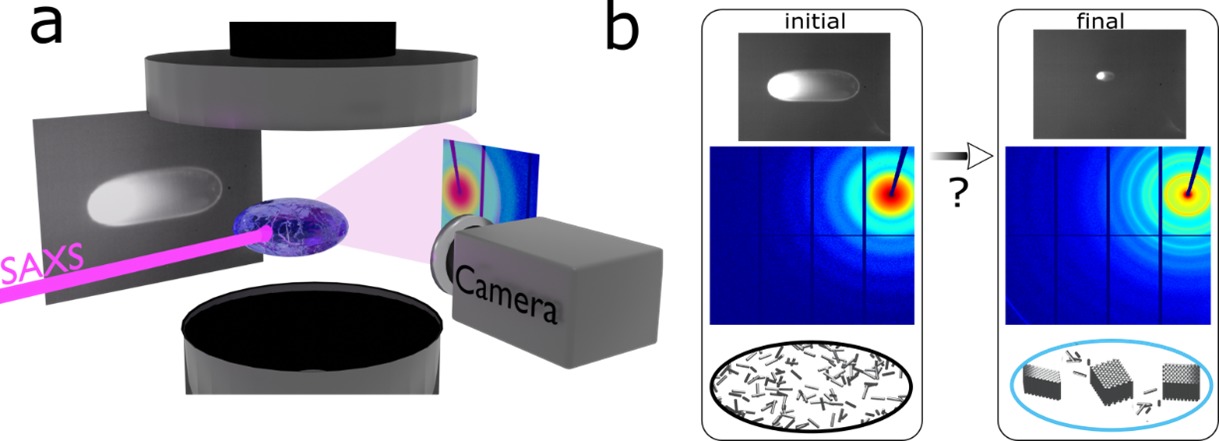
Figure: a) Schematic illustration of the setup to monitor EISA in levitated droplets. b) images of the shrinking droplet (top) and the corresponding 2D SAXS patterns (bottom) acquired at two different times, close to the beginning and the end of the process. |
15/06/2026 How do nanoparticles organize as a liquid droplet dries? A new study uncovers the key role of surfactants in directing the formation of ordered plasmonic materials. Evaporation-induced self-assembly (EISA) is a widely used strategy to transform dilute nanoparticle (NP) suspensions into highly ordered materials. However, despite its importance for nanoscience and materials engineering, the microscopic mechanisms governing this process remain incompletely understood, especially for anisotropic NPs dispersed in water. In a recent study, researchers [1] have shed new light on this question by investigating the drying dynamics of silver nanorods in the presence of a prevalent surfactant, cetyltrimethylammonium chloride (CTAC). Using an innovative experimental approach based on levitated droplets, the team was able to monitor in real time and without contact the structural evolution of NPs throughout the evaporation process. Their findings challenge a widely accepted view of EISA: while it is generally assumed that the progressive increase in concentration during drying drives the formation of ordered structures, the study demonstrates that the initial surfactant concentration is in fact the key parameter controlling the emergence of NP superlattices. This effect outweighs the influence of NP concentration and even of the particle shape. The researchers show that surfactant micelles play a dual and dynamic role: at early stages they act as depletants, inducing attractive interactions that trigger the nucleation and growth of ordered assemblies of nanorods. At later stages, as their concentration increases, these same micelles undergo a phase transition toward a gel-like state, which freezes the NPs assembly process. By combining time-resolved small-angle X-ray scattering with complementary electron microscopy and microbeam analyses, the team also reveals that ordering occurs before complete drying and extends across the entire droplet, leading to a radial organization of the nanorods at the mesoscale. These results provide practical guidelines for designing reproducible nanoparticle superlattices and open new perspectives for the fabrication of plasmonic metamaterials, photonic structures, and functional nanodevices. [1], le Laboratoire de Physique des Solides (CNRS/Université de Paris-Saclay), SWING beamline (SOLEIL Synchrotron, l'Institut Charles Sadron (CNRS/Université de Strasbourg) et le CIC Nanogune (Donostia San Sebastian, Espagne). DOI: 10.1021/acs.nanolett.6c01619 |